Your AI Has Wings. Why Are You Walking?
By Ahmad Ajmal, Founder & Product Lead, Upfinity Inc.
TL;DR
Most people use AI to walk. Here’s how the ones who fly do it, with the true stories behind them.
Inspired by Felix Rieseberg’s post, How to be more ambitious: A tutorial for humans with models.
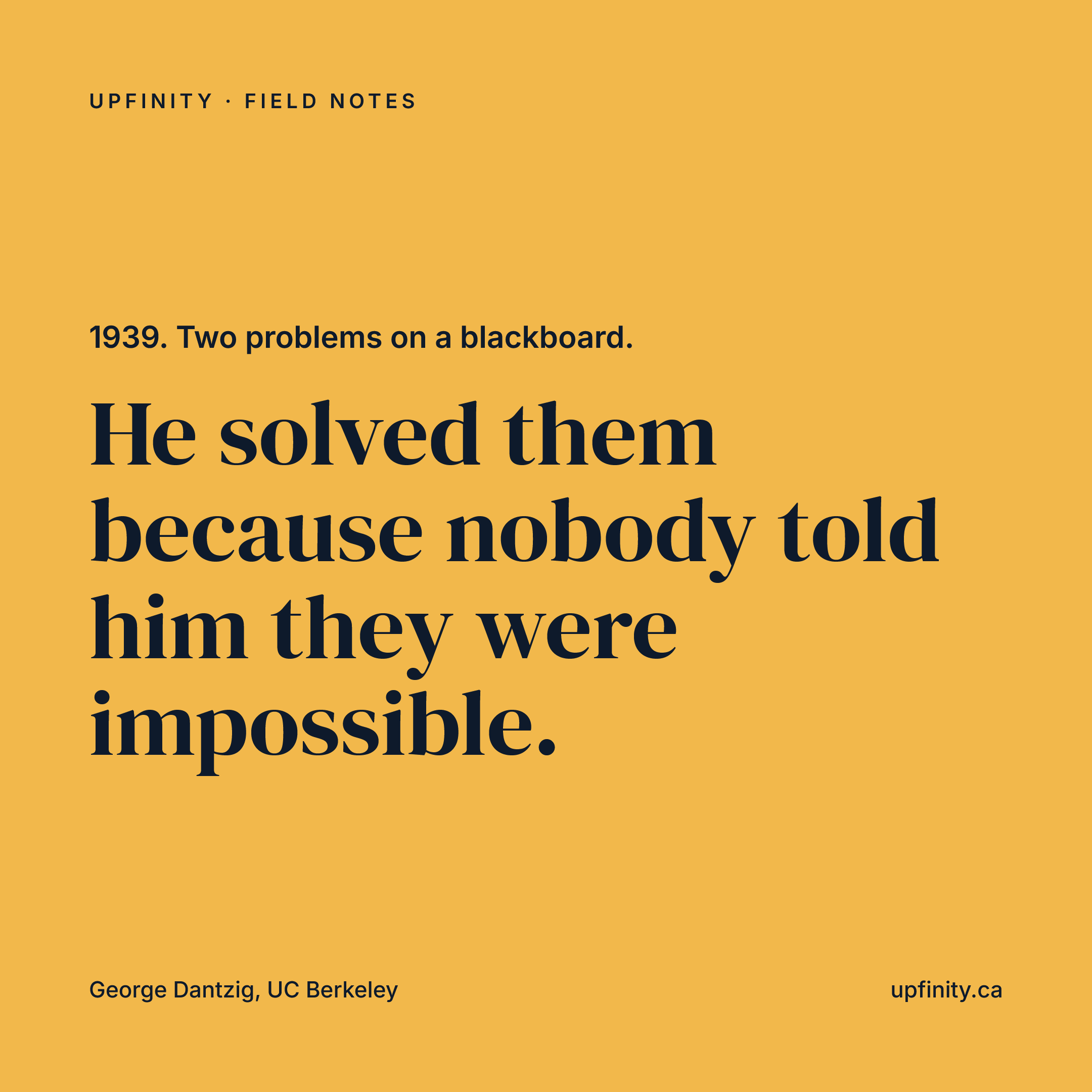
In 1939, a graduate student walked into a statistics class at Berkeley. He was late. He saw two problems on the blackboard, copied them down, and assumed they were homework.
They felt harder than usual. He took a few days. He handed them in.
They weren’t homework. They were two famous unsolved problems in statistics. George Dantzig solved them because nobody told him they were impossible.
Hold that thought. Because right now, millions of us are doing the exact opposite with AI.
We ask it for the capital of France. We ask it to make an email sound less angry. Then we shrug and say, “Useful, I guess.”
That’s a pair of wings used as a coat rack.
The gap nobody talks about
Felix Rieseberg has led engineering for Claude.ai, Cowork and Claude Code Desktop at Anthropic. Every day he learns of something done with AI that he hadn’t thought possible. This month, Claude may have helped an amateur astronomer discover a new planet. Mathematician Terence Tao is openly discussing a new era of math.
Meanwhile, many people are still stuck on email polish.
His explanation is simple. AI capabilities don’t grow evenly. They’re astounding in some directions and weak in others. A few people find the astounding directions. They look like they’re flying. Everyone else is still flapping.
He breaks ambition into four types: Speed, Altitude, Depth and Range.
Speed is doing the same work faster. Everyone gets that. It’s table stakes.
The other three are where companies and careers get rewritten.
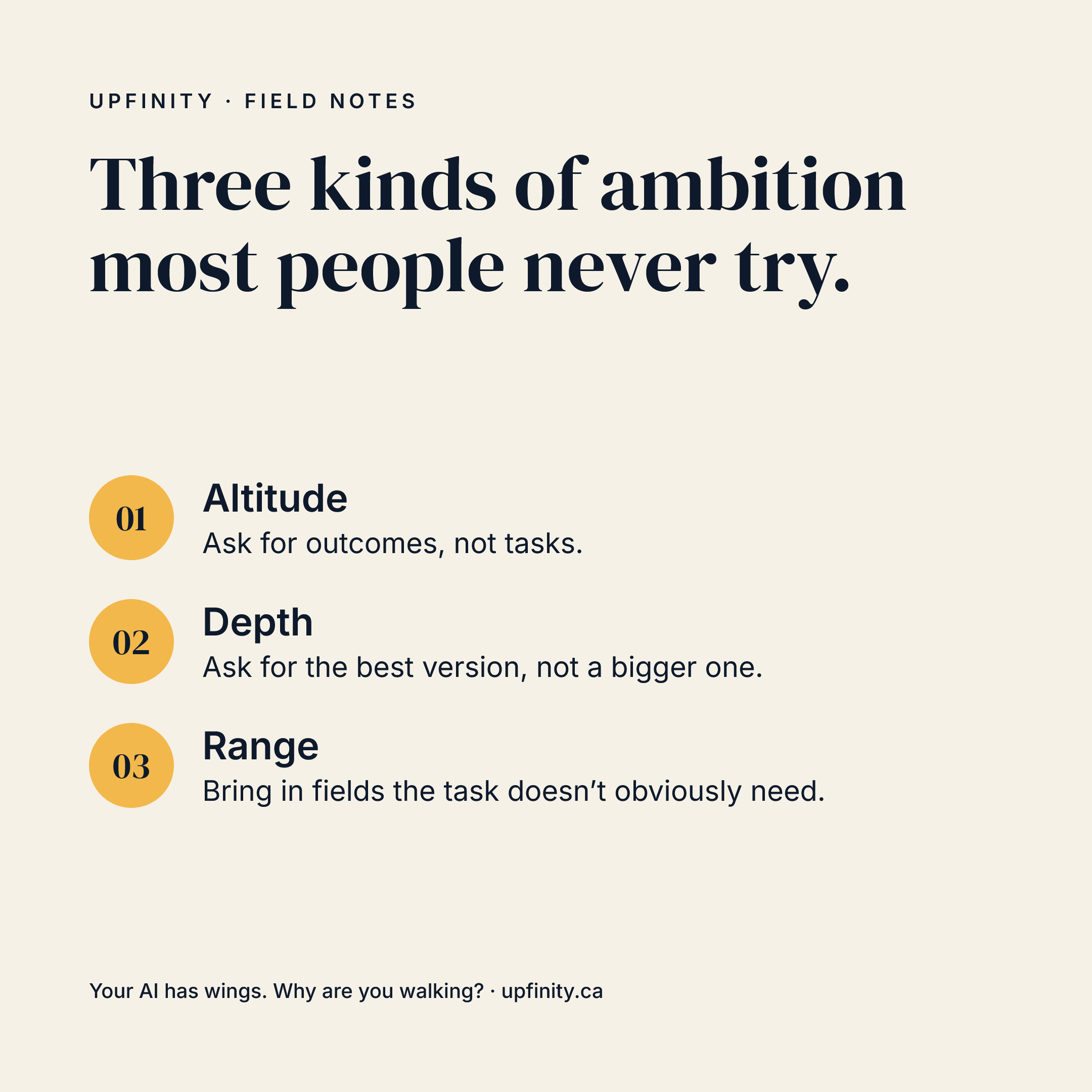
1. Altitude: Stop asking for tasks. Ask for outcomes.
In 1975, a young Kodak engineer named Steve Sasson built the first digital camera. Kodak kept it in the lab to protect its film business.
Its real business was capturing memories, not selling film. Kodak filed for bankruptcy in 2012.
Now look at Netflix. It mailed DVDs in red envelopes. But Reed Hastings understood the goal wasn’t the disc. The goal was getting entertainment to people. In 2007, it added streaming alongside the DVDs and kept betting on it until streaming became the business.
That’s altitude. Ask what you want to happen next. The goal beyond the goal.
Rieseberg lives this. He used to ask Claude to fix individual app crashes. Now he asks it to keep the apps crash-free. To make that work, he gave it crash reports, a map from app version to code commit, and real machines to reproduce bugs on.
Try this. Facing a quarterly business review? Don’t ask for slides. Ask:
“Tell me what changed this quarter, why, and what we should do about it. Then pick the three most urgent decisions and argue both sides of each.”
You just moved from making a deck to making decisions.
2. Depth: Ask for the best version, not a bigger one.
In 2010, British Cycling’s Dave Brailsford launched Team Sky with a bold promise: a British rider would win the Tour de France within five years. No British rider had ever won it.
Bradley Wiggins won in 2012. Two years early.
The method became famous: obsess over every detail, test everything, and let the data overrule tradition.
There’s science behind it too. Locke and Latham reviewed 35 years of goal-setting research. People given specific, hard goals consistently beat people told to “do their best.”
So push the model like Brailsford pushed his riders:
- Use the pros’ instruments. When Claude reaches for a simple table, insist on databases and statistical models.
- Pick unreasonable goals. Need a site to load in 5 seconds? Ask for 200 milliseconds. Tell the model it’s solvable.
- Attack your own beliefs. “We think churn is an onboarding problem. Try to disprove that from the raw data.”
- Use an outside judge. Don’t let the model grade its own homework. Give it a tool that checks the answer.
3. Range: Assemble the crew.
In 2002, the Oakland A’s had one of the lowest payrolls in baseball. They won 103 games.
Billy Beane didn’t out-spend anyone. He applied sabermetrics, a statistical approach pioneered by outsiders and undervalued by most teams. Scouts trusted their gut. Beane trusted numbers others overlooked.
That’s range. Pull in expertise from fields the task doesn’t obviously need.
Rieseberg’s trick is to swap nouns for verbs. A quarterly review isn’t “a deck.” It’s “getting busy people to believe a story about cause and effect, and decide under uncertainty, in 30 minutes.” Now you can see who to call: an analyst, a journalist, an editor. Add a short seller and a forensic accountant to attack it.
One warning. Don’t ask the model to write like a short seller. Ask it to do what a short seller does. Role play makes transcripts weird. Methods make results better.
He also saw a colleague use Blender to render interior designs. That sparked him to build a 3D environment for his own homepage. Different field. Same magic.
Why we hold ourselves back
Psychologists call it self-efficacy. Believe you can, and you do more.
The proof is everywhere:
- Roger Bannister broke the four-minute mile in May 1954. Then John Landy did it just 46 days later. Once someone proved it was possible, the wall disappeared.
- Michelangelo didn’t want to paint the Sistine Chapel. He was a sculptor, not a painter.
- Linus Torvalds announced Linux as “just a hobby.” Today it runs much of the internet.
- SpaceX failed three rocket launches in a row. The fourth reached orbit in 2008, just as the money ran out. Months later, NASA handed it a major contract.
Every one of them did something hard because they believed it was possible, saw someone else do it, or gave themselves permission to fail.
AI makes this more urgent. Capabilities now leap every few weeks. What felt impossible last quarter may be a Tuesday afternoon task today.
How we put this to work at Upfinity
We believe “impossible” is just a problem nobody has looked at from the right angle yet. So that’s where we start.
- Altitude. We build for the outcome, not the task. A hiring tool shouldn’t just score resumes. It should deliver a better hire, so ours runs the whole path from application to offer.
- Depth. “Looks right” is never the finish line. We audit our own work again and again, and we test people on real infrastructure, not simulations.
- Range. We look for answers outside the problem’s own field. The breakthrough usually lives one discipline over, in the place nobody thought to look.
I’ve seen this work. Before Upfinity, I built iFinance Pay. In late 2019, buy-now-pay-later was in its infancy, and instant credit existed only in small pockets.
I wanted shoppers to see an iFinance option next to credit cards at online checkout: one minute of questions, then an approval. Making that real meant virtual cards funded just in time, on real-time payment architecture.
Call after call, card infrastructure companies told me to white-label their product, which would have made our work useless.
So I did the homework instead: more conversations, every piece of public research I could find, then an infrastructure plan built around what we actually needed. It worked like a charm.
In April 2022, Iceberg Finance acquired iFinance Canada, doubling its business volume and making it a top 10 player in Canada’s specialty finance industry. The group has since passed $1 billion in loans, and its CEO was named Technopreneur of the Year at the 2024 CanadianSME awards.
The barrier is rarely the physics. It’s the perspective. We keep trying new ones.
Three prompts to steal today
- Altitude: “What’s the goal beyond this task? Redesign how we get that outcome, and show from our own history that it works.”
- Depth: “Give me a deeper version of this task, not a bigger one. What would a top professional do that I’m not asking for, and what would prove the result is right?”
- Range: “Rewrite this task as verbs. Which fields do those verbs point to? Bring in the methods they use.”
The bottom line
George Dantzig didn’t know the problems were impossible. You do. That’s the only difference.
Drop the assumption. Pick the audacious goal. Hand your AI a real computer, real data and a real outside judge.
Then watch what happens.
At Upfinity, we build AI-native software for companies that refuse to think small. Got a problem you’ve been told is impossible? Build what’s next. Move the world forward. Let’s talk.
More in AI & Machine Learning
Want help applying this?
We build AI-native software for teams navigating exactly this kind of shift.
Start a conversation